
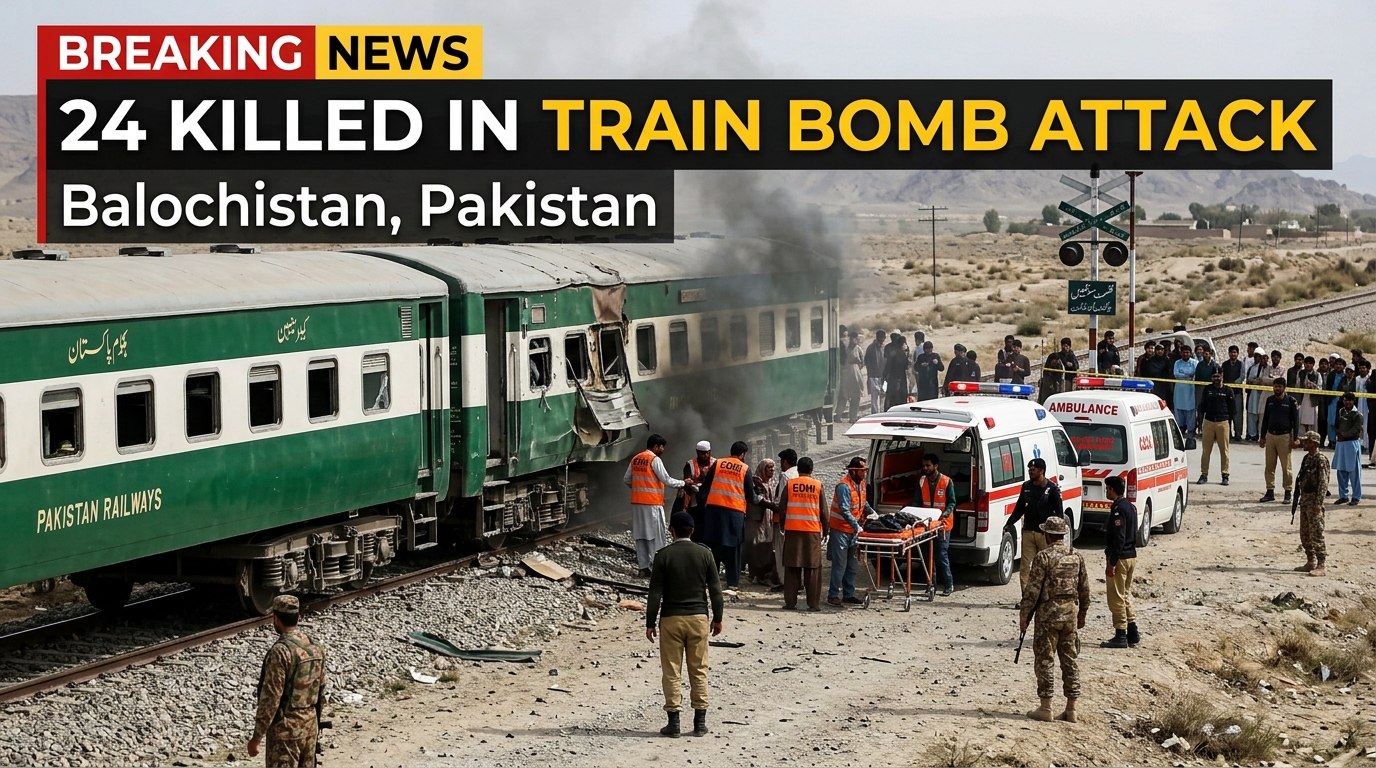
Balochistan Train Bomb Attack Kills 24 in Deadly Suicide Explosion
Introduction
The Balochistan train bomb attack has shocked Pakistan after a deadly suicide car bomb targeted a passenger train in Quetta, killing at least 24 people and injuring dozens more. The tragic incident highlights the ongoing security challenges in Balochistan, where militant violence and separatist attacks continue to threaten public safety and transportation networks.
Also read:
Eid ul Adha 2026 Mandi Updates in Pakistan – Latest Bakra, Cow & Bull Prices Today
Authorities immediately launched rescue operations and initiated a large-scale investigation into the bombing.
Suicide Explosion Hits Passenger Train in Quetta
The attack occurred near a railway crossing in Quetta, the capital city of Balochistan province. According to initial reports, an explosives-filled vehicle rammed into a moving passenger train carrying civilians and security personnel.
The powerful blast caused severe destruction, damaging train compartments, nearby vehicles, and surrounding infrastructure. Witnesses reported hearing a massive explosion followed by thick smoke covering the area.
Emergency teams, police officers, and security personnel quickly reached the blast site to rescue passengers and secure the area.
Death Toll Rises After the Balochistan Train Bomb Attack
Officials confirmed that at least 24 people lost their lives in the Balochistan train bomb attack, while many others suffered serious injuries. Several injured victims remain in critical condition at hospitals in Quetta.
Medical authorities declared emergency situations in local hospitals to handle the increasing number of casualties. Ambulances transported injured passengers throughout the day as rescue workers searched damaged train compartments for survivors.
The tragic incident has left families across Pakistan mourning the loss of innocent lives.
Militants Suspected Behind the Attack
Pakistani authorities are investigating possible militant involvement in the bombing. Early reports suggest that the separatist militant organization known as the Baloch Liberation Army (BLA) claimed responsibility for the attack.
Security agencies are collecting forensic evidence and reviewing intelligence reports to determine how the bombing was planned and executed.
Officials stated that all possible angles are being examined before final conclusions are announced regarding the attackers and their support networks.
Government Response to the Balochistan Train Bomb Attack
Prime Minister Shehbaz Sharif strongly condemned the bombing and described it as a cowardly act of terrorism targeting innocent civilians.
Government officials promised strict action against militant groups responsible for destabilizing the country. Security operations have reportedly intensified across sensitive regions of Balochistan following the attack.
The bombing has also renewed national discussions about transportation security, counterterrorism strategies, and public safety measures in Pakistan.
Security Challenges in Balochistan
Balochistan remains one of Pakistan’s most sensitive provinces due to long-standing insurgency, separatist violence, and militant activity.
Armed groups operating in the region frequently target security forces, infrastructure, highways, railway systems, and government institutions. Experts believe transportation networks are especially vulnerable because they connect remote areas with major cities across Pakistan.
The latest Balochistan train bomb attack demonstrates how militant violence can disrupt travel, create fear among civilians, and damage economic stability.
Impact on Pakistan Railways
Pakistan Railways serves millions of passengers annually and plays an important role in national transportation and trade.
Following the Balochistan train bomb attack, railway authorities increased security measures at railway stations, crossings, and sensitive travel routes. Additional security checkpoints and patrol teams have also been deployed in several areas.
Passengers traveling through Balochistan may experience enhanced security screenings and delays while authorities continue investigations.
International Concern Over Rising Violence
The deadly bombing has attracted international attention, with several governments and organizations expressing concern about worsening security conditions in Pakistan’s southwestern region.
Security analysts warn that continued instability in Balochistan could impact regional trade projects, infrastructure development, and foreign investment initiatives connected to Pakistan.
Counterterrorism experts are emphasizing the importance of stronger intelligence coordination and preventive measures to reduce the risk of future attacks.
Investigation Continues
Authorities continue to investigate the Balochistan train bomb attack while forensic experts examine evidence collected from the blast site.
Security officials are working to identify individuals involved in planning, financing, and supporting the suicide bombing. More details are expected as the investigation progresses.
The government has assured the public that additional steps will be taken to strengthen railway security and protect civilians from future threats.
(FAQs)
1. What is the Balochistan train bomb attack?
The Balochistan train bomb attack was a deadly suicide bombing targeting a passenger train in Quetta, Pakistan.
2. Where did the attack happen?
The explosion occurred near a railway crossing in Quetta, the capital of Balochistan province.
3. How many people died in the attack?
At least 24 people were killed, while dozens suffered injuries.
4. Was the attack a suicide bombing?
Yes, authorities believe the attack involved a suicide car bomb.
5. Who claimed responsibility?
Reports suggest the Baloch Liberation Army claimed responsibility for the bombing.
6. Were civilians among the victims?
Yes, civilians traveling on the train were among those killed and injured.
7. What actions has the government taken?
The government condemned the attack and increased security operations across sensitive areas.
8. Why is Balochistan considered unstable?
The province has experienced insurgency, separatist violence, and militant attacks for many years.
9. Is railway security being increased?
Yes, Pakistan Railways and security agencies have strengthened security monitoring and patrols.
10. Is the investigation still ongoing?
Yes, authorities continue investigating the attack and collecting forensic evidence.
Conclusion
The Balochistan train bomb attack represents another tragic reminder of the security challenges facing Pakistan. As authorities continue investigations and strengthen counterterrorism operations, the country mourns the victims of this devastating incident.
Improved railway security, intelligence coordination, and long-term stability efforts will remain critical in preventing similar attacks in the future.
Disclaimer
This article is based on publicly available reports and official statements available at the time of publication. Information may change as authorities release updated details.
Official Website Link
Pakistan Railways Official Website
FOLLOW UPS FOR MORE UPDATES:
Whatsapp:
https://whatsapp.com/channel/0029Vb7bBGqGpLHYH9ZEnU3H